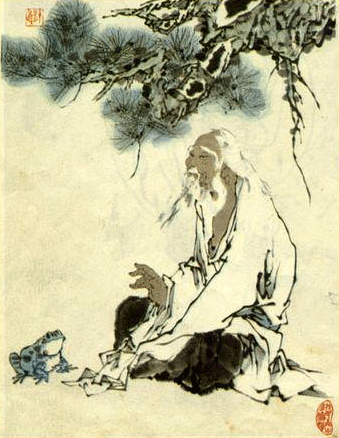
The Interwoven Nature of Existence
Chuang Tzu's assertion, "There is nothing that is not 'that'; there is nothing that is not 'this,'" invites us into a profound exploration of the interconnectedness of all things. In essence, he suggests that every aspect of existence is both a unique expression and a part of a greater whole. This realization challenges our conventional perceptions of separation and duality, urging us to embrace a more holistic understanding of reality. The stakes of this teaching are high; they compel us to reconsider our identities, our relationships, and our place within the cosmos.
Delving deeper, we find that this quote encapsulates the essence of relativity, a theme that resonates throughout Chuang Tzu's work. By asserting that everything is both 'this' and 'that,' he encourages us to transcend rigid categorizations and binary thinking. This perspective not only fosters a sense of unity but also invites a more compassionate engagement with the world. In a time marked by division and conflict, the wisdom of Chuang Tzu serves as a gentle reminder of our shared existence and the fluidity of our perceptions.
The image / the metaphor
At first glance, the imagery in Chuang Tzu's quote may seem deceptively simple, yet it is rich with layers of meaning. The terms 'this' and 'that' evoke a sense of immediacy and presence, while simultaneously suggesting a broader context. The use of 'is not' implies a negation of fixed definitions, inviting us to explore the fluidity of existence. This interplay between the specific and the general creates a felt sense of connection, as if Chuang Tzu is urging us to recognize the threads that weave through the fabric of life.
Going deeper, the metaphor of 'this' and 'that' serves as a bridge between the individual and the universal. It challenges us to see beyond our immediate experiences and to recognize the shared essence that binds all beings. In this light, 'this' can represent our personal experiences, while 'that' embodies the larger tapestry of existence. The beauty of this metaphor lies in its ability to dissolve the boundaries we often impose, inviting us to embrace the complexity and richness of life as an interconnected whole.
In the speaker's tradition
Chuang Tzu's teachings are deeply rooted in the Taoist tradition, which emphasizes the importance of harmony with the Tao, or the fundamental nature of the universe. Concepts such as wu wei (non-action) and yin-yang (the interplay of opposites) resonate with the idea that all things are interdependent and constantly in flux. The notion of relativity in Chuang Tzu's quote aligns with the Taoist understanding of sunyata (emptiness), suggesting that our perceptions are shaped by context and that true wisdom lies in recognizing the impermanence of all things.
In the text of the Zhuangzi, we find numerous anecdotes that illustrate the fluidity of identity and the interconnectedness of existence. For instance, the story of the butterfly dream challenges the distinction between reality and illusion, echoing the sentiment of Chuang Tzu's quote. This narrative invites us to question our assumptions and to embrace the uncertainty that accompanies the human experience, ultimately leading us to a deeper understanding of our place within the cosmos.
Living the teaching
Consider a modern scenario where this teaching might resonate: a heated discussion about differing political views. In such moments, the rigid categorization of 'us' versus 'them' often leads to conflict and misunderstanding. By embracing Chuang Tzu's perspective, we can recognize that beneath our differing opinions lies a shared humanity. This awareness allows us to engage in dialogue with compassion, fostering a sense of connection rather than division. In this way, the teaching becomes a practical tool for navigating the complexities of contemporary life.
Another application of this wisdom can be found in our relationships. When faced with a disagreement with a loved one, we might instinctively cling to our perspective, viewing it as the only valid truth. However, by acknowledging that both 'this' and 'that' hold value, we can cultivate empathy and understanding. This shift in perception not only deepens our connections but also enriches our experience of love and companionship, reminding us that our differences are part of a larger, interconnected narrative.
A reflection
As we contemplate Chuang Tzu's profound assertion, we are invited to reflect on the nature of our own perceptions. How often do we find ourselves caught in the dualities of 'this' and 'that,' failing to recognize the underlying unity that connects us all? In moments of division or conflict, how might we shift our perspective to embrace the fluidity of existence? This contemplation encourages us to explore the spaces between our certainties, inviting a deeper understanding of ourselves and the world around us.



Join the BrightStar Community
Stay connected with daily inspiration, event announcements, and community wisdom